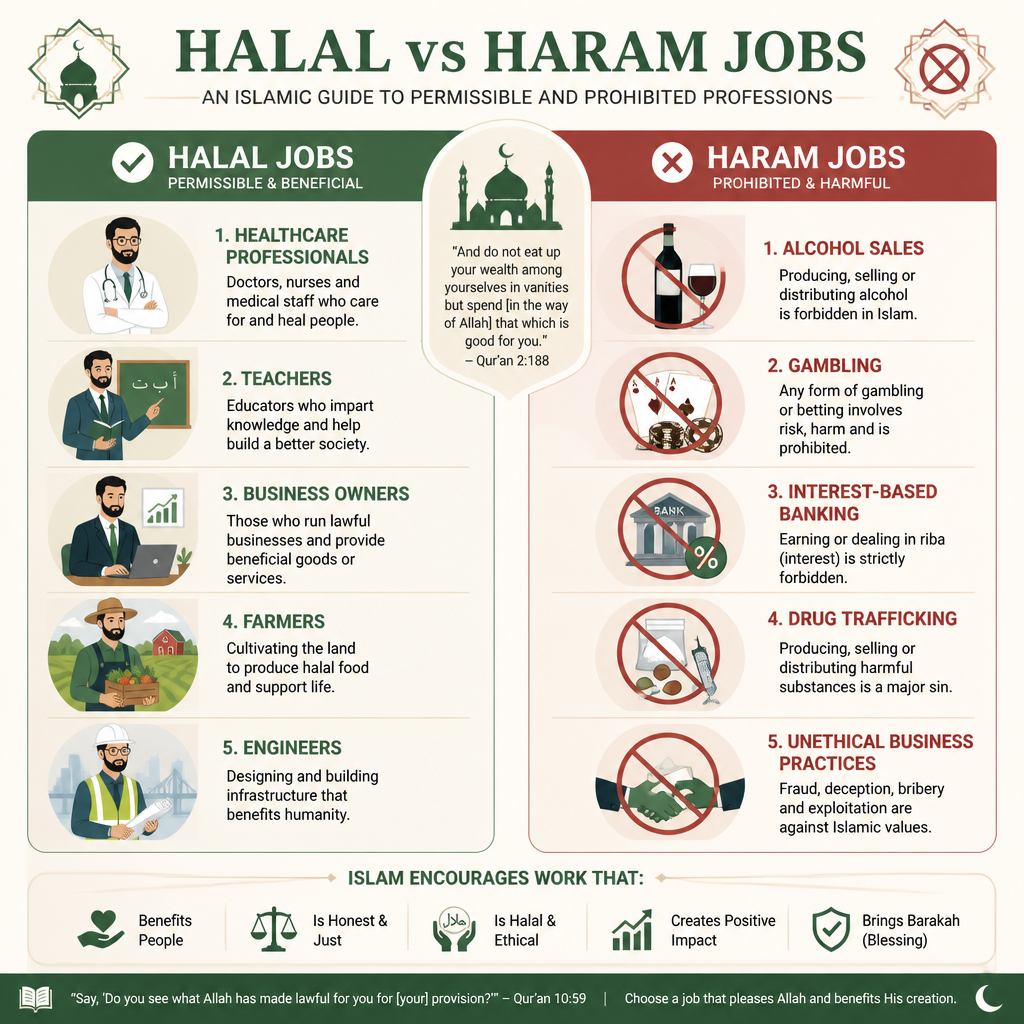
Discover which jobs are halal in Islam and learn how to choose a career that aligns with Islamic principles. Comprehensive guide to permissible professions, haram occupations, and ethical employment in Islam.
Introduction
In today’s diverse job market, Muslims often face important questions about career choices: Is my job halal? Does my profession align with Islamic values? Understanding what jobs are halal in Islam is essential for every Muslim seeking to earn a living while maintaining their faith and pleasing Allah (SWT).
Islam provides comprehensive guidance on all aspects of life, including our professional careers. The Prophet Muhammad (peace be upon him) said: “Seeking halal earnings is a duty after the duty” (Al-Bayhaqi). This emphasizes the importance of choosing permissible professions that not only provide sustenance but also contribute positively to society.
This comprehensive guide will help you understand Islamic principles regarding employment, identify halal and haram occupations, and make informed career decisions that align with your faith.
Understanding Halal and Haram in Employment
What Does “Halal” Mean?
In Arabic, “halal” means “permissible” or “lawful” according to Islamic law (Shariah). When it comes to employment, a halal job is one that:
- Does not involve prohibited (haram) activities
- Provides genuine value to society
- Involves fair and honest transactions
- Does not harm individuals or communities
- Complies with Islamic ethical standards
The Importance of Halal Earnings
Islam places tremendous emphasis on earning through permissible means. The Quran states:
“O you who have believed, eat from the good things which We have provided for you and be grateful to Allah if it is [indeed] Him that you worship.” (Quran 2:172)
The Prophet Muhammad (PBUH) also warned: “O people, Allah is Pure and only accepts that which is pure… Then he mentioned a man who, having journeyed far, is disheveled and dusty and who spreads out his hands to the sky saying, ‘O Lord! O Lord!’ while his food is unlawful, his drink is unlawful, his clothing is unlawful, and he is nourished unlawfully, so how can he be answered?” (Sahih Muslim)
Core Islamic Principles for Career Selection
1. Intention (Niyyah)
Your intention matters greatly in Islam. Working to provide for your family, contribute to society, and fulfill your obligations to Allah can transform even mundane tasks into acts of worship.
2. Benefit to Society (Maslahah)
Islam encourages professions that benefit humanity. The Prophet Muhammad (PBUH) said: “The best of people are those who bring most benefit to the rest of mankind.” (Al-Mu’jam al-Awsat)
3. Honesty and Integrity
Regardless of your profession, honesty in all dealings is paramount. Deception, fraud, and exploitation are strictly forbidden.
4. Avoiding Harm (La Darar wa La Dirar)
Islamic law emphasizes “no harm and no reciprocating harm.” Jobs that cause harm to individuals, society, or the environment should be avoided.
5. Fair Treatment and Justice
Employers and employees alike must uphold justice. Workers deserve fair wages, safe conditions, and dignified treatment, while employers deserve honest work and loyalty.
Halal Jobs and Professions in Islam
Healthcare and Medicine
Examples: Doctors, nurses, pharmacists, dentists, medical researchers, physical therapists
Healthcare professions are highly encouraged in Islam as they preserve life, one of the five essential objectives (Maqasid) of Shariah. The Prophet Muhammad (PBUH) said: “There is no disease that Allah has created, except that He also has created its treatment.” (Sahih Bukhari)
Why it’s halal:
- Saves and improves lives
- Alleviates suffering
- Fulfills the Islamic duty of preserving life
- Provides essential community service
Education and Teaching
Examples: Teachers, professors, trainers, educational administrators, child care providers
Knowledge holds a special place in Islam. The first revelation to Prophet Muhammad (PBUH) was “Read!” (Iqra), emphasizing the importance of learning and teaching.
Why it’s halal:
- Spreads beneficial knowledge
- Shapes future generations
- Fulfills the Islamic obligation of seeking and sharing knowledge
- Builds stronger communities
For more insights on ethical practices in various sectors, explore our guide on ethical employment practices that align with Islamic values.
Business and Entrepreneurship
Examples: Retailers, wholesalers, manufacturers, e-commerce sellers, consultants (in permissible fields)
The Prophet Muhammad (PBUH) himself was a successful businessman before prophethood, known for his honesty and integrity, earning the title “Al-Sadiq” (The Truthful).
Why it’s halal (when conducted properly):
- Provides goods and services people need
- Creates employment opportunities
- Contributes to economic development
- Allows for creative problem-solving
Key conditions:
- No involvement in haram products (alcohol, pork, gambling, etc.)
- Honest advertising and pricing
- Fair treatment of employees and customers
- Avoidance of interest-based transactions (riba)
Understanding Islamic finance principles is crucial for Muslim entrepreneurs to ensure their business transactions remain Shariah-compliant.
Technology and IT
Examples: Software developers, IT consultants, cybersecurity experts, data analysts, web developers (for permissible content)
Technology careers are generally halal when used for beneficial purposes and not for spreading harm or immorality.
Why it’s halal:
- Solves real-world problems
- Improves efficiency and connectivity
- Can be used for Islamic education and outreach
- Drives innovation and progress
Engineering and Construction
Examples: Civil engineers, architects, mechanical engineers, electrical engineers, construction workers
Building infrastructure and creating functional spaces serves society and is highly valued in Islam.
Why it’s halal:
- Creates beneficial infrastructure
- Provides shelter and safe spaces
- Supports community development
- Applies knowledge for practical benefit
Agriculture and Farming
Examples: Farmers, agricultural engineers, veterinarians, food producers
Agriculture is one of the most praised professions in Islam. The Prophet Muhammad (PBUH) said: “There is no Muslim who plants a tree or sows seeds, and then a bird, or a person or an animal eats from it, but it is regarded as a charitable gift for him.” (Sahih Bukhari)
Why it’s halal:
- Provides essential food
- Sustains life
- Environmental stewardship
- Continuous charity (sadaqah jariyah)
Creative and Media Fields
Examples: Graphic designers, writers, photographers, videographers (for permissible content), marketers (for halal products)
Creative professions are halal when the content produced aligns with Islamic values.
Why it’s halal (with conditions):
- Communicates beneficial messages
- Promotes good and discourages evil
- Enhances understanding and awareness
- Must avoid promoting haram content
Public Service and Government
Examples: Civil servants, police officers (upholding justice), judges, social workers, firefighters
Serving the community through public service is highly meritorious in Islam when done with sincerity and justice.
Why it’s halal:
- Maintains social order
- Protects rights of people
- Provides essential services
- Upholds justice and fairness
Skilled Trades
Examples: Carpenters, plumbers, electricians, mechanics, tailors
Skilled trades are honorable professions that provide essential services to communities.
Why it’s halal:
- Meets practical needs
- Requires skill and expertise
- Provides honest livelihood
- Supports community infrastructure
Haram (Prohibited) Jobs in Islam
Just as Islam guides us toward permissible careers, it clearly prohibits certain occupations. Understanding what makes a job haram helps Muslims avoid questionable income sources.
Jobs Involving Interest (Riba)
Examples: Conventional banking employees involved in interest transactions, loan officers at riba-based institutions, mortgage brokers dealing with interest
The Quran strongly condemns riba: “Allah has permitted trade and has forbidden interest.” (Quran 2:275)
Why it’s haram:
- Explicitly prohibited in Quran and Sunnah
- Exploits those in need
- Creates unjust wealth transfer
- Contradicts Islamic economic principles
Alcohol and Intoxicants Industry
Examples: Bartenders, brewery workers, wine producers, distributors of alcoholic beverages, servers in establishments primarily serving alcohol
The Prophet Muhammad (PBUH) cursed ten people related to alcohol: the one who presses it, the one for whom it is pressed, the one who drinks it, the one who carries it, the one to whom it is carried, the one who serves it, the one who sells it, the one who consumes its price, the one who buys it, and the one for whom it is bought. (Sunan Ibn Majah)
Why it’s haram:
- Alcohol is explicitly forbidden in Islam
- Causes harm to individuals and society
- Involvement at any level is prohibited
- Supports an industry that destroys lives
Pork and Non-Halal Meat Industry
Examples: Pig farmers, pork processors, sellers of non-halal meat, workers in conventional slaughterhouses not following Islamic guidelines
Allah says in the Quran: “He has only forbidden to you dead animals, blood, the flesh of swine…” (Quran 2:173)
Why it’s haram:
- Pork is explicitly forbidden
- Handling haram substances for trade is prohibited
- Contradicts dietary laws in Islam
Gambling and Casinos
Examples: Casino workers, lottery ticket sellers, bookmakers, online gambling platform employees
“O you who have believed, indeed, intoxicants, gambling, [sacrificing on] stone alters [to other than Allah], and divining arrows are but defilement from the work of Satan, so avoid it that you may be successful.” (Quran 5:90)
Why it’s haram:
- Explicitly forbidden in Quran
- Based on chance and exploitation
- Causes addiction and financial ruin
- Wealth transfer without productive work
Prostitution and Adult Entertainment
Examples: Sex workers, pimps, adult film producers, workers in brothels, pornographers
Islam strictly prohibits all forms of sexual immorality and exploitation.
Why it’s haram:
- Violates Islamic morality
- Exploits human dignity
- Destroys families and society
- Major sin in Islam
Idol Manufacturing and Fortune Telling
Examples: Statue makers for worship, astrologers, fortune tellers, psychics claiming knowledge of the unseen
Why it’s haram:
- Promotes shirk (associating partners with Allah)
- Claims knowledge that belongs only to Allah
- Misleads people
- Contradicts Tawheed (monotheism)
Deceptive and Fraudulent Practices
Examples: Scammers, con artists, counterfeiters, those who sell defective goods without disclosure
The Prophet Muhammad (PBUH) said: “He who cheats us is not one of us.” (Sahih Muslim)
Why it’s haram:
- Violates trust
- Steals from people
- Destroys social fabric
- Oppression and injustice
Weapons of Mass Destruction and Oppression
Examples: Manufacturing weapons for unjust wars, working for oppressive regimes to harm innocent people
Why it’s haram:
- Causes mass harm and death
- Supports oppression
- Violates sanctity of life
- Contradicts Islamic principles of justice
Gray Areas and Questionable Occupations
Not all jobs are clearly halal or haram. Some professions fall into gray areas requiring careful consideration:
Conventional Insurance
While insurance provides important protection, conventional insurance often involves elements of gharar (uncertainty) and riba (interest). Many scholars recommend halal certification bodies’ approved Takaful (Islamic insurance) alternatives.
Entertainment Industry
Working in entertainment requires case-by-case evaluation:
- Halal: Educational content, wholesome family entertainment, Islamic media
- Haram: Content promoting immorality, violence, or un-Islamic values
- Gray area: Depends on content, message, and impact
Working for Mixed Businesses
What if a company sells both halal and haram products? Scholars differ:
- Some say avoid entirely if haram is significant
- Others permit if your specific role doesn’t involve haram
- Best practice: Seek fully halal employers when possible
Music and Arts
Scholars have varying opinions on music. Generally:
- Permissible: Instruments and content that don’t promote haram
- Prohibited: Content that leads to sin or immorality
- When in doubt, seek knowledgeable scholarly guidance
How to Determine if a Job is Halal
Use this framework to evaluate potential careers:
1. Examine the Core Activity
What is the primary product or service? Does it contradict Islamic teachings?
2. Assess the Impact
Does this job benefit or harm society? Does it promote good or evil?
3. Review Financial Transactions
Are there elements of riba, gharar, or fraud? Are contracts fair and transparent?
4. Consider the Work Environment
Will you be forced to compromise Islamic values? Is there free mixing that violates Islamic guidelines?
5. Evaluate Your Specific Role
Even in a generally permissible company, your specific duties must be halal.
6. Seek Knowledge
When uncertain, consult qualified Islamic scholars who understand both Shariah and modern business contexts.
7. Make Istikhara
Pray Salat al-Istikhara (prayer for guidance) when making important career decisions.
Special Considerations for Muslim Professionals
Women in the Workplace
Islam permits women to work provided:
- The work itself is halal
- Islamic dress code (hijab) is maintained
- Interaction with non-mahram men follows Islamic guidelines
- Family responsibilities are not neglected
- The environment is safe and respectful
Working in Non-Muslim Countries
Muslims living in non-Muslim majority countries can work in permissible jobs while:
- Maintaining Islamic identity
- Avoiding haram activities
- Being ambassadors of Islam through excellent character
- Contributing positively to society
Career Changes and Transitioning
If you’re currently in a haram job:
- Make sincere repentance (tawbah)
- Begin searching for halal alternatives immediately
- Don’t delay unnecessarily, but be practical
- Seek support from community and family
- Trust in Allah’s provision (rizq)
- Consider temporary measures if needed while transitioning
Remember: Allah promises to provide for those who leave something for His sake.
The Spiritual Dimensions of Work in Islam
Work as Worship (Ibadah)
In Islam, work isn’t just about earning money—it’s an act of worship when done with the right intention. The Prophet Muhammad (PBUH) said: “If one of you dies while holding a rope (working) to gather firewood to sell and be self-sufficient, it is better for him than begging from people.” (Sahih Bukhari)
Barakah in Halal Earnings
Halal income carries barakah (divine blessing), meaning:
- Your money goes further
- You experience contentment
- Your family is protected
- Your prayers are more likely to be answered
- You gain peace of mind
Accountability in the Hereafter
We will be questioned about our earnings on the Day of Judgment. The Prophet Muhammad (PBUH) said: “The son of Adam will not be dismissed from before his Lord on the Day of Resurrection until he has been questioned about five things: his life and how he spent it, his youth and how he used it, his wealth and how he earned it and how he spent it, and how he acted upon what he knew.” (Sunan al-Tirmidhi)
Practical Steps to Ensure Halal Employment
For Job Seekers
- Research potential employers thoroughly
- Ask questions during interviews about company practices
- Review job descriptions carefully
- Network with other Muslim professionals
- Consider starting your own halal business
- Don’t compromise on haram elements for higher salary
For Employers
- Ensure all business activities are Shariah-compliant
- Pay employees fairly and on time
- Create respectful, dignified work environments
- Avoid exploitation and oppression
- Give workers their rights before their sweat dries (Hadith)
- Consider Islamic finance options for business funding
For Employees Already Working
- Regularly audit your job responsibilities
- Speak up if asked to do something haram
- Document concerns if necessary
- Have an exit strategy if your job becomes compromised
- Continuously educate yourself on Islamic work ethics
Case Studies: Real-World Scenarios
Case 1: The Software Developer
Scenario: Ahmed is offered a job developing apps for a company that creates both educational software and gambling apps.
Solution: Ahmed should clarify his role. If he’ll work exclusively on educational projects with no involvement in gambling apps, some scholars permit this. However, the safest option is seeking employment with a company whose entire business is halal.
Case 2: The Marketing Professional
Scenario: Sarah works in marketing and is asked to promote a new product line that includes alcohol.
Solution: Sarah should politely decline this specific assignment. If the company insists or this becomes a regular expectation, she should consider finding alternative employment, as promoting haram products is not permissible.
Case 3: The Restaurant Worker
Scenario: Yusuf needs a job and is offered work at a restaurant that serves both halal food and alcohol.
Solution: Scholars differ on this. Some permit working in the kitchen preparing halal food if you have no involvement with alcohol service. Others recommend avoiding such establishments entirely. Yusuf should seek the most cautious path and look for fully halal restaurants if possible.
The Role of Islamic Finance in Career Choices
Understanding Islamic finance principles is crucial for many professions. Whether you’re an entrepreneur, investor, or employee in the financial sector, knowing how to avoid riba and structure transactions Islamically is essential.
For those interested in finance careers, consider specializing in Islamic banking, Takaful (Islamic insurance), or Shariah-compliant investment management. These growing fields allow Muslims to contribute to the economy while maintaining religious integrity.
Learn more about Islamic finance to understand how you can build a career in this ethical financial system.
Building a Halal Career Path: Action Plan
Short-Term Actions (This Week)
- Evaluate your current job against Islamic guidelines
- Make a list of your skills and how they can be used in halal industries
- Research halal companies in your field
- Connect with Muslim professional networks
Medium-Term Actions (This Month)
- Update your resume highlighting transferable skills
- Begin applying to halal-compliant companies
- Consider additional training or certification if needed
- Consult with a knowledgeable scholar about specific concerns
Long-Term Actions (This Year)
- Transition to a fully halal career if currently in haram work
- Build expertise in your chosen halal field
- Mentor other Muslims seeking halal employment
- Consider entrepreneurship if opportunities are limited
Frequently Asked Questions (FAQs)
Q: Is it halal to work in a bank that deals with interest?
A: Working in conventional banks that deal with riba is problematic. If your role directly involves interest transactions (loan officer, mortgage broker), it’s haram. Some scholars permit back-office roles with no direct involvement in riba, but the safest approach is seeking employment in Islamic banks or halal industries.
Q: Can Muslims work in the military or police force?
A: Yes, serving in military or police is generally halal when the purpose is defending the innocent, maintaining justice, and protecting society. However, participating in unjust wars or oppressing people is haram.
Q: Is dropshipping halal?
A: Dropshipping can be halal if:
- Products sold are permissible
- You clearly disclose product details
- No deception is involved
- Transactions are fair and transparent
- You avoid interest-based financing
Q: Can I work for a company that donates to haram causes?
A: This requires careful evaluation. If the company’s primary business is halal but they make some haram donations, your salary is generally still halal. However, you should advise against such donations if possible and consider whether your employment indirectly supports these causes.
Q: What if I can’t find a halal job in my field?
A: Consider:
- Relocating to areas with more opportunities
- Starting your own halal business
- Retraining for a different halal profession
- Taking a temporary permissible job while searching
- Trusting that Allah will provide for those who fear Him
Conclusion: Choosing a Career That Pleases Allah
Selecting a halal career is one of the most important decisions a Muslim can make. It affects not just your worldly success, but your spiritual well-being and eternal destiny. While the path may sometimes be challenging—especially when haram options appear more lucrative or accessible—the peace of mind, barakah, and divine pleasure that come from halal earnings are incomparable.
Remember the words of the Prophet Muhammad (PBUH): “Know that what has passed you by was not going to befall you, and what has befallen you was not going to pass you by.” (Sunan al-Tirmidhi) Your rizq (provision) is written by Allah, and no haram job will increase it beyond what Allah has decreed.
As you navigate your career journey:
- Prioritize your deen over worldly gain
- Seek knowledge continuously
- Make dua for guidance and provision
- Trust in Allah’s plan
- Be patient during transitions
- Remember that halal may come slower but lasts longer
May Allah (SWT) grant us all halal provision, bless our efforts, and make our work a means of drawing closer to Him. Ameen.
Additional Resources
- Explore halal certification to understand how products and services are verified as permissible
- Learn about ethical employment practices from an Islamic perspective
- Deepen your understanding of Islamic finance for career opportunities in this growing sector
Disclaimer: This article provides general guidance based on Islamic principles. For specific situations, always consult with qualified Islamic scholars who can provide fatwas based on your individual circumstances.